
Blog Post
Reimagining Your Fleet: What AI Really Means for Fleet Leaders
By Wheels
December 9, 2025
A conversation with Parsh Wanath, Head of Digital Project Engineering and Advanced Analytics, Wheels and Mike Camnetar, Fleet Services Manager, General Mills.
The fleet industry is no stranger to transformation. Over the past decade, this industry has navigated electrification, supply-chain disruptions, and connected vehicle technologies. But artificial intelligence (AI) feels different. Its potential is vast and so are the questions it raises.
To explore that, Mike Camnetar and Parsh Wanath recently sat down to discuss what AI really is, how it’s being used today, and how fleet professionals can prepare for what’s ahead. The following conversation resulted.
Understanding What AI Really Means for Fleets
Mike: At General Mills, our leadership recently challenged every employee to set a personal AI goal for the year. That’s when it hit me: this isn’t a passing trend, it’s a fundamental shift. But as a fleet manager, I also realized I needed to understand what AI actually means for my world. Fleet managers are hearing a lot about AI but may not understand what it really means in practice. Parsh, can you break it down?
Parsh: Absolutely. “Artificial Intelligence” is a broad term, it refers to machines or software that can perform tasks that typically require human intelligence, such as recognizing patterns, making predictions, or generating content.
Within AI, you’ll often hear about machine learning (ML)this is a subset of AI that allows systems to learn from data and improve over time without being explicitly programmed. There are three primary types of machine learning:
- Supervised learning. Think of this as teaching by example. You feed the model labeled data, say, photos of cats and dogs, and it learns to tell them apart. In fleet terms, this could mean using past maintenance records to predict which vehicles might have future issues.
- Unsupervised learning. This is when the algorithm looks for patterns on its own, like clustering similar data points. For fleets, that might involve grouping drivers by similar behavior or identifying fuel consumption anomalies.
- Reinforcement learning. Here, the system learns through trial and error, receiving feedback along the way. It’s similar to coaching a driver – rewarding good performance and correcting unsafe behavior.
Then there’s generative AI, which goes a step further. Instead of just finding patterns, it can create new content, writing, images, even code, based on what it has learned. Tools like ChatGPT or Copilot fall into this category.
How Machine Learning is Already Enhancing Fleet Management
Mike: That helps a lot. So how is machine learning being applied in fleet management today?
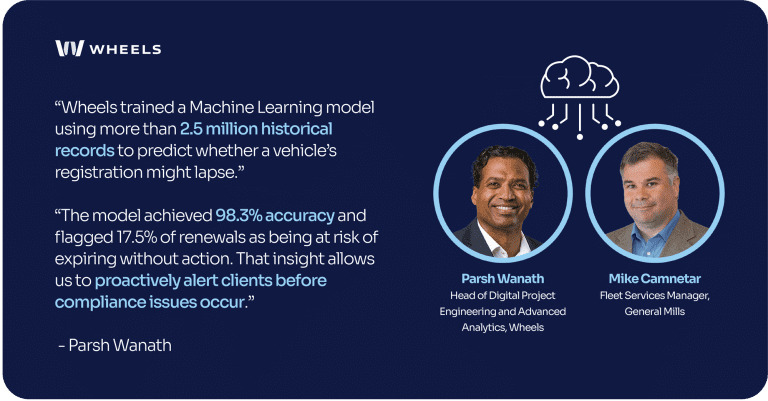
Parsh: One great example is how Wheels uses machine learning for registration renewals. We trained a model using more than 2.5 million historical records to predict whether a vehicle’s registration might lapse. You might say, that’s easy – just look at the date on the registration. But there are some other factors that are not so easily controlled. These include the response times of the drivers and timing at the DMVs. With AI we can take those factors into account and identify which are “at risk” renewals, flag them as a priority and promptly assign specialists to them.
The results are impressive. The model achieved 98.3% accuracy and flagged 17.5% of renewals as being at risk of expiring without action. That insight allows us to proactively alert clients before compliance issues occur, reducing downtime and avoiding fines.
That’s just one application. Predictive maintenance, accident prevention, and fuel fraud detection are other key areas where AI is already adding value.
Predictive Maintenance: A New Era of Proactive Fleet Care
Mike: Let’s talk about predictive maintenance. I’m reminded of my days at GE Fleet, where we coordinated with our friends at GE Aviation and used data from aircraft engines to anticipate failures before they happened. It shifted our mindset from reactive to proactive maintenance and saved an enormous amount of time and cost.
This is something we’ve heard about for years. What’s different for fleet now that AI is involved?
Parsh: Fleet data – odometer readings, diagnostic trouble codes, telematics, and even weather – can be used to predict when a part is likely to fail. AI identifies subtle signals humans might miss. Instead of waiting for a breakdown, fleets can schedule repairs strategically, keeping vehicles on the road and improving driver safety.
Mike: Of course, this mindset will necessitate the willingness to replace a part that isn’t broken. We will need to learn to place trust in AI.
AI for Fleet Safety: Preventing Accidents Before They Happen
Mike: Accident prevention sounds like another powerful use case. How can AI help there?
Parsh: There is huge potential there, Mike. The U.S. Department of Transportation reports that there are about 210 accidents per 10,000 fleet vehicles, and roughly 37% are preventable. With AI, we can use telematics and driver data to build risk models that flag at-risk drivers based on speeding, harsh braking, distracted driving, or environmental factors like weather and time of day.
These insights allow fleets to intervene early through coaching, alerts, or training before an incident happens.
Mike: That’s a game changer. Historically, fleets have been more reactive. For example, we only talk to drivers after an accident. AI lets us move to a preventive model, which is better for both people and budgets.

Fuel Fraud Detection: How AI Strengthens Fleet Spend Control
Mike: How about fuel? Fuel is usually the second largest spend item of a fleet behind depreciation, and fuel fraud has always been another ongoing headache. How can AI help?
Parsh: AI is excellent at anomaly detection. It can learn what “normal” fueling behavior looks like and flag anything unusual. For example, a purchase outside of a driver’s route, an unusually large fill-up, or fueling that occurs when the vehicle isn’t present.
Mike: That’s similar to how credit card companies flag suspicious transactions. For instance, if I charge something weird, I may get a ping from my credit card app that says, “hey, did you just make this charge? Yes or no?”. And if I don’t answer they’ll turn my card off, which is annoying, but at the same time, I like having that level of protection. For fleets, that kind of automated vigilance could save thousands in lost fuel costs.
Generative AI & Large Language Models: What Fleet Leaders Need to Know
Mike:Let’s shift to generative AI and large language models like ChatGPT. How does that differ from what we’ve discussed?
Parsh: The biggest difference is purpose. Machine learning is about recognizing patterns and making predictions, while generative AI is about creating new content from what it has learned.
Generative models are trained on massive datasets, text, images, video, and can then generate something new: a report, an email draft, even computer code. The latest versions are approaching what’s known as “reasoning AI.” They can understand context, make logical inferences, and carry out multi-step tasks autonomously.
We’re also seeing the rise of agentic AI, which refers to systems that can take action independently, like scheduling a meeting or running an analysis without direct human input.
How Fleet Managers Can Use Generative AI Today
Mike: That sounds powerful, but also a bit overwhelming. How can fleet managers practically use generative AI today?
Parsh: The easiest entry point is productivity. Generative AI can help draft driver communications, summarize meeting notes, or analyze fleet data.
At Wheels, we’re also using AI to generate policy recommendations. For example, if a client wants to update their fleet safety policy, our system can search internal best practices and produce a customized draft in seconds.
Mike: That’s similar to what we’re doing at General Mills. We’ve rolled out a custom internal AI assistant that lets employees interact with company data securely asking questions like, “What’s our safety training completion rate?” or “Show me our latest fuel spend report.” We’ve also run “Prompt Like a Boss” workshops to help employees write effective AI prompts.
The time savings are enormous, but tone matters. We’ve learned that AI is a starting point, it’s up to people to bring empathy and context to the final product.
Where Fleet Leaders Should Begin on Their AI Journey
Mike: For fleet leaders who are just starting to explore AI, where should they begin?
Parsh: Fleet leaders should start small but strategic. Think about AI as a journey, not a one-time project. My suggestions would be:
- Define your AI ambition. Identify where AI can add the most value, back-office efficiency, operational optimization, or driver safety.
- Plan your investments. AI success requires more than tools; it’s about people, processes, and culture.
- Establish an AI strategy. That means clear vision, talent development, change management, and strong governance.
Above all, remember: AI isn’t here to replace people, it’s here to amplify human expertise. The best outcomes happen when technology and experience work hand in hand.
Why AI Is Becoming Essential for Safer, Smarter, Mort Efficient Fleets
Mike: AI feels different from past fleet innovations. What strikes me most is that AI isn’t just another fleet technology, it’s a business transformation tool. It’s reshaping how we make decisions, how we plan for risk, and even how we define productivity. Like any major change, it comes with a learning curve, but the potential upside is enormous. AI can help us run safer, smarter, and more sustainable fleets. The key is to stay curious and experiment. The more you explore it, the more you realize it’s not about replacing people it’s about equipping them with sharper insights and better tools.
Parsh: I completely agree. We’re entering a new phase where data, automation, and human judgment intersect. The fleets that succeed will be the ones that embrace AI strategically, anchoring it in real business goals, guided by ethics, and built around people. Responsible AI isn’t just a compliance requirement; it’s a leadership mindset.
As organizations gain experience, they’ll discover that AI isn’t confined to the back office or IT department, it will become part of every decision we make, from policy setting to driver engagement. The fleets that start building literacy and trust in AI now will be better prepared for the next decade of innovation.
Mike: Exactly. Fleet management has always been about balance – cost, safety, service, and sustainability. AI doesn’t change that; it strengthens our ability to achieve it. The technology may evolve quickly, but our mission stays the same: to move people and products efficiently, responsibly, and safely.
Parsh: Well said. We need to move forward realizing that the future of fleet isn’t just automated, it will be intelligently human.
About the Authors:
Parsh Wanath is Head of Digital Project Engineering and Advanced Analytics at Wheels, a leading fleet management and mobility solutions provider.
Mike Camnetar is Fleet Services Manager at General Mills, a member of the NAFA Board of Directors and former NAFA President.